Lately, I’ve listening to a lot of FM radio. Car-related radio commercials form an interesting subgenre of ads. Two have stuck in my mind. The first is a Subaru ad, where a man talks about his romantic trips to a rural area with his girlfriend, and describes the feeling of watching other people drag their cars out of the mud. Luckily, the speaker will never be in that dishonorable position. He says, “I’ve never wanted to be the guy asking his neighbor for a push. That’s why I got a Subaru Legacy.” I mean, god forbid a man ever ask someone else for help, right?
The other ad: A deep, masculine voice insists, “You didn’t buy that beige minivan to turn heads. So it’s embarrassing when your brakes squeak at every stop sign.” Is it really? Or is having squeaky brakes just part of owning a car, the natural result of regular driving?
Both of these ads exploit a perceived ideal of what it means to own and drive a car. My friend Julia suggested that the Subaru commercial might be trying to resist the brand’s lesbian associations, and I think there’s truth in that. The first ad I mention is about a man, providing for a woman, and asserting his self-reliance and independence from his neighbors. The second ad says, We know you don’t really want to drive a car that’s practical for parents, so you best not let people see you drive it. After all, if you were a truly independent man, you sure as hell wouldn’t be driving a minivan (or have any children to schlep around).
real men save the denim for their pants
The automotive industry is built on masculine anxiety. This point hardly needs to be stressed. Consider the nostalgic representations of the 1950s, where a young man takes a woman out in his car for a night on the town. Consider Grease, where male sexuality is tied to the power of an engine. Consider Top Gear, Pimp My Ride, or the notorious car collections of Seinfeld and Leno. As a cultural icon, the automobile embodies men, power, and independence.
Complete with an unmistakable bulge
There was a time when the car was the Great American Object. Once Henry Ford figured out the assembly line, and made cars increasingly accessible, to be young and free (and male) was to own and operate an automobile.
Now That’s What I Call Disruptive
Recently, cars have been losing their cachet. In a 2014 poll by Zipcar, most Millenials would rather sacrifice a car than a smartphone. Social media has changed how we connect with one another, and smartphones have driven these developments. Phones can integrate themselves into our everyday lives in ways that computers can’t. Roughly speaking, computers are to phones as railroads are to cars. Trains were a crucial development in transportation, but they weren’t the distinctly American icon that cars turned out to be. And pretty much everyone can have a phone. Compared to cars, phones are cheap to buy, easy to use, and cost little to maintain. For many low-income people (and plenty of others), phones are the main way of getting online. Of course, most people can afford smartphones because they agree to pay phone companies for years of service. But, relative to cars, phones are a pretty good deal.
Smartphones represent something markedly different than automobiles. Social media is all about being connected, relating to others, sharing information. No more are our objects designed to provide independence and freedom, but to create new forms of interaction and community.
How are smartphone users gendered? Pretty feminine. Think of the iconic teenage girl using all of her family’s monthly minutes, a gendered archetype that’s been around since before the phone scene in Bye Bye Birdie. In The Honeymooners, it was Alice, Ralph Kramden’s wife, who wanted a phone in the house. The 2013 song “#Selfie” features a female voice declaring that she must use her cell phone to document every moment of her night out. And yet the associations of smartphones aren’t nearly as aggressive as with cars. Publications such as Wired and TechCrunch demonstrate how modern technology can very much be something for men. BUT, consider how smartphones become masculine: as a business opportunity, a thing to “hack,” a problem to be solved. In the world of smartphones, men are always a step ahead, looking for emerging markets and “disruptive” apps.
A rare occasion when men are pushed aside
Consider the image of Steve Jobs, the forefather of startup fetishism, standing on that stage holding an iPhone. This man, like Henry Ford, is distributing a gift, an object that will change our lives. And all the big names in tech innovating are men — Bill Gates, Mark Zuckerberg, Elon Musk. Even when it comes to products and platforms meant to connect people, it’s the individual (male) entrepreneur that gets the most credit.
Aww, the face of a man who truly cares
Of course, claiming either Henry Ford or Steve Jobs as solely responsible for their products is completely dishonest. Henry Ford’s great development was the assembly line — a means of getting other people to do a lot of work, in a particular way. And Jobs made the smartphone so widely accessible by employing masses of workers to do mundane labor overseas, often in despicable conditions that we would never accept in the United States. The fantasy that any single person is wholly responsible for an invention is always false. After all, someone (probably a woman) had to wipe baby Mark Zuckerberg’s ass.
Okay, so clearly the smartphone (and truly I mean the iPhone, as all smartphones are a facsimile of that Apple icon), maintain some gender distinction between male producers/innovators and female consumers. But this divide is much less strict than we see in Subaru’s masculinist radio commercials. iPhone ads are known for the simplicity and blankness meant to make their product appear “universal.” But Apple actually goes beyond universality, as their advertisements foreclose on the possibility for the world to exist outside of their products. Their advertisements co-opt the language of change and revolution, proclaiming the only relevant social progress is the latest advances of tech.
The perennial revolution is always already happening
When I was in high school, I hated cars. Of course, I grew up in Brooklyn, so I never really needed one. But. crucially, I had a bicycle. Riding my bike kind of became my thing in high school (and every teen loves to have a thing). Cycling was more than how I got around. I interned at the nonprofit shop Recycle-a-Bicycle and learned to build my own bike. I rode my bike to Occupy Wall Street, and saw how people were directly, physically, challenging hierarchies of power and privilege. The summer after my first year in college, I interned at Bike New York, and learned to teach kids how to ride bikes safely.
it me (+ my friend Sam). I rode my bike to this museum more times than I want to remember
Bicycles came to me at a good time in my life. For a teen, bikes were risky enough to be thrilling, but also provided exercise, and the opportunity to learn about my own interest. Several of my best friends were also into bikes, and riding allowed us to explore and connect with the city. Bike lanes and bike parking gave me causes to care about. I saw how cycling could immerse itself into the geography of a city, and mold a space into something better than it once was.
just kidding the revolution will not be on a billboard
Cycling is queer as hell. While yeah, bikes are marketed to specific genders, and certain jobs (bike messenger, tour de Francer) are more reserved for men, the bicycle subculture connected me with people of all genders and sexual identities. But, more importantly, bicycles can challenge hegemonic power. A human on a bicycle is the most efficient machine on Earth. As Bill Nye said, “A bowl of oatmeal, 30 miles, you can’t come close to that. Put a bowl of oatmeal in your car, you’re not going anywhere, let alone 30 miles.”
Most (good) bike shops are local businesses, and there’s a thriving market of bikes and bike parts on Craigslist and other peer-to-peer platforms. Bikes are something people can pretty easily fix and maintain themselves (as cars perhaps once were). Bicycles are powerful, beautiful, and revolutionary.
So what does this have to do with phones? Physical transportation is classified by those who have the most power. After the decline of U.S. railroads, car companies dominated American culture and led to the development of massive highway systems that completely shape the way we engage with space. In American cities, streets are designed for driving, or walking, with public transportation as an often positive — but bureaucrat and infrastructurally complex — alternative. But bicycles demonstrate how people, as individuals and collective communities, can imagine and create cheaper and more environmentally-friendly ways of moving through space. Can there be any equivalent object for smartphones? Like the automotive industry, tech is defined by gendered relationships of power. Is there some way to live through and within digital space without supporting exploitative labor, oppressive contracts, and economic precarity? Apple wants us to believe that tech innovators are responsible for all social change and progress. But we need not wait for a white man to tell us when – or how – to go.
“Pop-ups” used to be confined to children’s books and baseball fields. Now, the term has come to denote any kind of temporary establishment, from pop-up retail stores to restaurants, cafes, and cinemas. On any given weekend, these pervasive pop-ups pepper many major metropolises. (Try saying that ten times fast.)
It’s no coincidence that the term “pop-up” is associated with kids and sports. Pop-ups are fun! They’re spontaneous! They’re new! Pop-ups are also temporary, disposable. Like many of the products in our lives, they’re designed to be abandoned and replaced. Pop-ups are the flash-mobs of capitalists.
Being temporary, pop-ups allow business owners to maximize profits in a short amount of time. Pop-ups don’t improve the infrastructure of a city or provide long-term, stable jobs. In fact, many pop-ups actually depend on the absence of a healthy economy to find space and reap profit. In a CNBC from August 2015, Sebastian Lyall, a London start-up (oy vey) founder, says: “The base of pop-up culture rests on the abundance supply of empty spaces and shops. The aftermath of recession has assured that in every city, we have places which are empty. These places will be used by pop-up organizers and this trend will grow.” Reading this statement, I latched onto the term “organizer.” Organizers used to be the ones building solidarity and resistance, bringing together people who can empower communities to engender social change. Now, the market has adapted the “grassroots” strategies of social and political organizers, extracting capital from economic degradation.
We can describe the “spontaneous” pop-up economy with another term: precarious. In “Precarious Life and the Obligations of Cohabitation”, Judith Butler argues that precarity (the state of being precarious) is essential to life, but is conditioned by particular social and economic systems. Butler says that “precarity is to a large extent dependent upon the organization of economic and social relationships, the presence or absence of sustaining infrastructures and social and political institutions.” As I’ve mentioned, pop-ups don’t produce the sustainable infrastructure that supports people in a community. We don’t want pop-up housing, pop-up high schools, or pop-up sewers. Pop-up enterprise reveals how business owners prioritize profit over community development.
I admit, not all pop-ups are created equal, or even made for profit. There are green markets that pop up in low-income communities. There is a “Pop-up Audubon” in Brooklyn’s Prospect Park. Both of these exist to make services — healthy food or education — available to those who can’t always access them. In the case of Prospect Park, “pop-up” is hardly more than a hip term to help them market a feature of the park to visiting families. The Audubon is part of the infrastructure of a park that has existed and (I hope!) will exist for a long time. And even if pop-up green markets or other temporary initiatives benefit low-income communities, wouldn’t it be better to build long-term change? To create systems that guarantee everyone can always access food and other resources that they deserve?
Pop-ups allege to embody freedom. What they actually provide is the freedom for businesses to extract capital from a market without taking any permanent stake in the development of a community.
Earlier today, I went to Coney Island with my mother. Driving down Shore Parkway in Brooklyn, we passed a small children’s amusement park. Nostalgia-triggered, I gazed out the window and fondly recalled the hours spent on the mild, age-appropriate rides.
“I remember this place,” I say. But then I notice the sign: “Adventurer’s Park Family Entertainment Center.”
“Wait – what happened to Nellie Bly?”
“Oh…they changed that name years ago. But you used to looove Nellie Bly.” I did. To my very young self, Nellie Bly was more than an amusement park – it was a bottomless fountain of childhood bliss.
Until today, I didn’t know much about Nellie Bly (which is actually the pen name of Elizabeth Cochran Seaman). As Wikipedia tells us, Bly was the daughter of a laboring immigrant, and her journalistic methods revolutionized how we investigate the truth. Bly traveled around the world in 72 days from 1889 to 1890, and her journey inspired the theme of one family amusement park in Brooklyn, New York. Nellie Bly was a pioneer in several ways, and she remains a feminist icon.
There’s more to Bly’s life than I can mention in a short post. My point is, Nellie Bly was more than deserving of an amusement park, and it’s sad to see her name erased from a place I fondly remember. But – in a positive spin – remembering the Nellie Bly Amusement Park taught me about an important figure of American history.
As Coney Island, Brooklyn, and New York City evolve, we should consider Nellie Bly. Do we want the places we cherish to have bland and generic names, or should we use names to build historical consciousness and deepen our community? The name “Adventurer’s Park” turns adventure into a distant and abstract fantasy.
Nellie Bly bypassed gender norms, journalistic conventions, and the entire distance of planet earth. Her experiences prove that there’s enough adventure in our own history to make any fantasy appear lifeless and tame.
Today, like most days, I went to the gym. A body’s a useful thing to have at a gym, and mine came in handy while I was working out.
There are many different reasons for going to a gym. Currently, I have a membership that allows me to access every branch of New York Sports Club. I’ve attended a few different locations, and I find that gym-goers in Park Slope are less transparently vain than those in, say, Bensonhurst. This is a class thing. If you know anything about Brooklyn, maybe you know what I mean. In Park Slope — the bourgie mecca I know and love — working out tends to be about sustaining wellness rather than maximizing muscle or minimizing fat. In more working-class areas of Brooklyn, it’s fine to work out for the sake of being huge or thin, to invest self-worth in the shape of your body.
Moving between the branches of New York Sports Club, I see that context shapes how people see their bodies. Perhaps, in a neighborhood of upper-(middle) class professionals, exercise allows people to demonstrate control through continuity, while working-class people control their bodies by pursuing physical extremes.
The above hypothesis is a little dishonest. There’s one way that people shape their bodies that is often so taken for granted that we don’t even discuss it. Men work out differently from women. This was clear at Bowdoin, where the free-weight area in the basement was dominated by “bros” while most women remained upstairs doing cardio.
When trying to develop a workout routine, one of the first things you must address is your gender. Most fitness apps and websites tailor workouts to either men or women. Different genders have different standards of beauty and health. Ideally, men are expected to be muscular, women to be thin (but also kind of muscular?).
At this point, I’ve made a habit of going to the gym. I like doing it, and I don’t like not doing it, so I keep working out. But listen: I’m not a man, and also not a woman. What should I do with my body at the gym?
Gyms engender self-control. We work out because it makes us feel good, productive, motivated. Exercise is an investment, and also its own payoff. And yet, as a gender non-conforming person, I can see the mechanisms that gyms use to constrain their own clients. When I want to change should I use a locker room for women or men? Whom should I ask to spot my bench press? When I work out, should I focus on weights or cardio?
Being genderqueer, perhaps I need a workout that is more fluid, not split to cardio or weight training. I’m seeking a fitness experience that welcomes everyone similarly, regardless of their gender. Maybe, I should try crossfit.
(Thanks to Chris Cappello and John Branch for their contribution to these ideas.)
A kind of disclaimer: I don’t usually write about politics. In topics ranging from twitter to masculinity, porn to Christmas movies, I’ve certainly stuck to the mantra of “Write what you know.” And I’m often insecure about how little (I feel) I know about politics. But if I’ve talked to you about my honors project, you may know that I’ve thought a whole lot about irony.
Recently, Bernie Sanders sat down with Killer Mike in a long interview discussing Mike’s thoughts and concerns about Bernie’s campaign. It was a thoughtful, interesting conversation that let Bernie contextualize his beliefs within Killer Mike’s worldview.
That interview was also incredibly ironic. Before the interview was released, the below image circulated throughout social media.
This picture was popular because it’s funny. It surprises us to see a balding, white politician in a suit and peruse a soul food menu across from a big black rapper.
Hillary Clinton also did something that could be considered ironic. A few months ago, she appeared on Saturday Night Live in a skit where she played a bartender advising actor Kate McKinnon playing Hillary Clinton. Although it’s not really ironic for a presidential candidate to be on SNL, Hillary’s appearance meant to surprise viewers, to show that she could break out of her formal, political persona and really embrace her fun side.
But what happens in Hillary’s skit? One of the biggest laughs of the whole deal is when the bartender (Hillary) tells Hillary (Kate McKinnon), “It really is great how long you’ve supported gay marriage.” The Hillary character (Kate) responds “It could have been sooner,” and the bartender (Hillary) concedes: “Fair point.”
To quote (my beloved) David Foster Wallace: “make no mistake, irony tyrannizes us.” In his landmark essay, “E Unibus Pluram”, Wallace argues that television controls is viewers through self-reflexive irony. Irony, then, has power, so ironic images are inherently political.
And yet, two ironic images don’t have to use irony in the same way. While some images (the kind that Wallace derides) look towards themselves in self-reflection, other representations gesture outwards, awakening viewers to greater realities.
Bernie and Hillary embody these two functions of irony. When Hillary pretends to be a bartender who reassures an actor who plays Hillary criticizing herself, she gets to have it both ways. In the moment of humor, the audience accept that Hillary compliments herself on advocating gay marriage while she acknowledges her belated support.
For Hillary, the irony, the joke, is all about her. She laughs at herself because it makes her seem cool, hip, self-aware. It’s not clear if she’s learned from her past actions, and if that’ll affect her future political career. As seen below, the SNL appearance was an uncomfortable fist pump with herself.
Yes, talking to Killer Mike made Bernie Sanders seem hip. In fact, it made him seem a hell of a lot more relevant among young people than he would on an NBC comedy show. But Bernie didn’t talk to Mike just to make himself look cool. As I said, we’re surprised to see Bernie sit in a soul food restaurant across from Mike, a big black rapper. This irony isn’t just a glib way for Bernie to dismiss an important issue. Rather, his conversation with Mike revealed our prejudice. We don’t expect a presidential candidate to talk to a rapper, even if that rapper is an important voice for an underrepresented community. By talking to Mike, Bernie makes us consider the different cultural groups that mainstream political coverage ignores.
If you want, you can extrapolate this argument to the entire campaigns of Hillary and Bernie. But I’ll say, it seems a lot more progressive to talk to someone new, with a different perspective on American politics, than to talk back and forth to yourself.
I had written the following to read at Park Slope United Methodist Church this past Sunday. Due to a recent tragedy with church members, I didn’t actually preach, but I wanted to share what I wrote:
Okay, so many of you know me, though I’m sure more of you know my mother and my sister. Although I haven’t come to church regularly in about eight years, I was excited about this opportunity to share my experiences and ideas. Thank you for having me.
So, my faith journey has as much to do with my body as my spirit. When my mother first mentioned that PSUMC was looking for people to preach this summer, she said that each week someone would talk about a different deadly sin. It seems that they scrapped that idea, but I immediately knew that I would want to discuss gluttony.
When I told my mother this, her first response was “What do you know about glutton?” If you were around when I was younger, you’ll know that I was a pretty heavy kid. I liked to eat, a lot. As I grew up, I learned more about nutrition and fitness, and began to monitor my eating habits to control my weight. Several of my close family members suffer from diabetes, so health (and disease) has long been on my mind. So, if I’m so dedicated to nutrition, wat do I know about gluttony? As I’m sure many of you know, those who restrict themselves the most often crave the most indulgence.
There are many ways to control food intake. As a math major and number-lover, I found it helped to count calories. You may be familiar with myfitnesspal, an app that can track what and how much you eat. With this program, everything you ingest has a nutritional value you can enter into a budget. The app separates food from its physical reality by turning it into a digital symbol.
In modern America, we are no strangers to the symbolic value of food. In 2013, Coca-Cola spent 3.3 billion dollars in advertising to convince you that a bubbly brown mixture full of corn syrup and acid would make you feel happier and less alone. We’ve all seen those cans of soda with random names on them – that eerily successful “Share a Coke” campaign.
Soda = Love
All types of food represent culture. Different cultures and ethnicities eat various things for various reasons. Here, we eat cookies at Christmas, and barbeque on the fourth of July. Food can also define individual identity. Commercials tell us that bacon cheeseburgers are for men, while low-fat yogurt is for women. And on the Food Network, culinary blogs and across Instagram, food becomes a competition, a hobby, and a work of art.
yogurt for women
Food also takes on moral significance. We hear about “guilt-free” desserts made without much sugar, and organic chips lacking Genetically Modified Organisms, or GMOs. Food manufacturers have even used the bible to sell products. “Ezekiel Sprouted-Grain Bread” is made from an all-natural recipe allegedly inspired by Ezekiel 4:9. Sometimes the cultural and moral significance of food intersects. White people have long used watermelon and fried chicken to ridicule Black culture.
not a bagel, but still holy bread
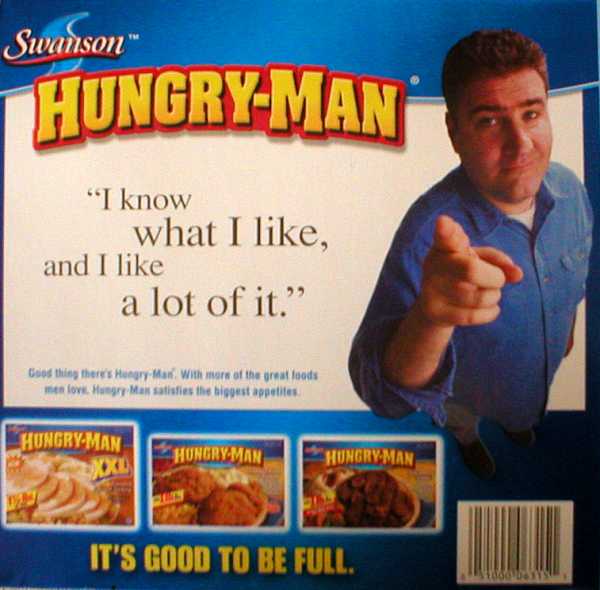
There’s one moral label particularly important to me: “cruelty-free.” This designates food without any animal products: no meat, dairy, eggs or honey. In other words, vegan. I decided to become vegan about a year and a half ago, and this decision is key to my relationship with gluttony. Veganism raises an interesting distinction. Many of the morals attached to food affect only the eater. Guilt-free dessert will save you calories, non-GMO snacks might help you avoid wonky chemicals, and Hungry Man dinners make you feel more masculine. However, consuming meat always implicates another living being. By eating animal produces, one contributes to a system that gives pain to and takes life from other animals. These different types of morals are important to my ideas about gluttony.
men eat meat
I’ve been talking about food, but consumption means a lot of things in 2015. Our lives are full of YouTube videos, Facebook messages, Snapchats, news articles, gifs, TV shows, podcasts, etc. And of course, there are still plenty of books. I also major in English, and I absolutely love to read. If anyone can be a literary glutton, it’s me.
*Takes out a few big books for visual effect: War and Peace, Infinite Jest, In Search of Lost Time, Gravity’s Rainbow* These are some of the books I’ve enjoyed in the last few years. I mentioned that I haven’t attended church regularly in several years. I always had an issue with the dogma of Christianity. After all, there are so many beautiful and powerful books that people use to find meaning. Why spend every Sunday talking about the same one? Besides, I hate being told what to do. Yet the funny thing is, the more I explored literature, the more I could make sense of my religious upbringing. When learning about different religions, beliefs, and systems of meaning, I often recalled bible lessons from those years of Sunday school.
There is one book I’ve been spending a lot of time with lately that I don’t particularly like: this review book for the GRE standardized test, which I’m preparing to take at the end of this month. The book advises that I study for the test by using index cards to group similar words together into various categories. So, under “Prevent/Obscure,” the book lists discomfit, encumber, fetter, hinder, impede, occlude and thwart. Askance, awry, circumnavigate, labyrinth, meander, serrated, sidle, undulating and vortex all fall under the category “Not a straight line.” This may be a useful way to study for multiple choice vocabulary questions, but these index cards condense the intricacies of language into vague and narrow groups. Standardized testing, the basis of public education, turns knowledge into a commodity, and segregates students according to a rigid value. Unlike the books I love, this GRE review guide doesn’t reveal anything new or interesting about the world, but just helps me conform to the bureaucratic doctrine of standardized knowledge.
Christianity often blurs the distinction between literature and language. We say that the word of God “nourishes our soul.” We speak of “the word made flesh” – that same flesh we eat together at communion. In John 6:63, Jesus says, “The words that I have spoken to you are spirit and life.” In giving life, food and language work together to sustain our existence. In John 6:56, Jesus says, “Those who eat my flesh and drink my blood abide I me, and I in them.” Jesus is the bread of life, and yet we learn about Jesus by reading a book, and engage with him by following his words.
As I said, many other books I have read have reminded me of lessons from Church. I realize that, by absorbing studying, and criticizing various texts and media, I learn to interpret and trust the bible. Rather than being a concrete dogma, scripture, life food, provides energy. However, we can decide how to use the spiritual calories.
I’ve mentioned the moral implications of food. Other kinds of consumption also signify morality. Parents complain about kids who spend too much time with screens, and not enough time outside. We use the phrase “binge watching” for a long time spent watching TV, which can make us feel lazy, or unproductive. And (so I hear) the internet is filled with just about every imaginable type of pornography.
When you’re wasting time watching YouTube, browsing Facebook or taking quizzes on Buzzfeed, you may feel excessive or wasteful. But, if those are the individual dangers of consumption, what about when media harms others? How about when McDonald’s advertises Happy Meals to children, or local news features Black criminals every night, or Law and Order portrays a selfless and infallible police force? The stories and images of media represent relationships of power. Good content can challenge our preconceptions and force us to think critically about the world. But, media often panders to our insecurities, entertains our delusions and reinforces unjust structures of race, gender and wealth. But how do we know the difference? Who gets to decide when “viewer discretion is advised?”
If stories and images have all these problematic implications, what kind of media should Christians consume? Should we limit ourselves to just the bible? Well, one book just wasn’t enough for me. I needed to read widely and diversely to find meaning in scripture. Jesus says that we should eat the bread of his flesh. How do we know when we’re reading the word of God, and when we’re consuming rotten content?
Speaking of consumption, I haven’t even mentioned the way we spend money. Economic consumption could easily take up a whole sermon. If it’s difficult to decide what to read, it’s even harder to know what to buy, in a global market where sweat shops and brand loyalty complicate even the most basic purchases.
Becoming vegan was interesting. At first, I obsessed over all the foods I couldn’t eat: the Brooklyn pizza I had loved my entire life, the steak I would never have in Paris, the cannoli I had eaten at my grandmother’s house every Christmas. But, I soon realized how many interesting ingredients and flavors I had missed by centering meals on animal products. Rather than restrictive, a vegan diet can be expansive, fulfilling, and truly guilt-free. But what about the other kinds of consumption? Instead of watching news shows that represent black, low-income neighborhoods as hubs of laziness and violence, I could follow the many activists on Twitter that uncover police brutality and insist that Black lives matter. Instead of drooling over the Kardashians, I can read books that challenge preconceptions of wealth and gender in America. Or I can consume all of these things, but always think about where God resides in each. I think that, no God worth believing can be dismissed by critical thinking. Lots of people try to argue about what we should read, watch hear and eat. But only you can say when a word, or a snack, truly nourishes your soul.
Did you ever play Mafia? Every group has their own house rules, but most games go like this” A group of people (the “town”) sit in a circle, and close their eyes while one appointed person (“God”) chooses “mafia” and a “detective.” The game works in cycles, where every “night” the group closes their eyes, and the mafia “wakes up” to choose people to kill. The detective knows the identity of the mafia, but the other townspeople don’t know for sure who the detective is. When everyone wakes up, the God orchestrates some tale to explain how the chosen person dies, and the rest of the town tries to figure out who’s in the mafia.
As teenagers, my sister and I were in our church’s youth group. During youth group meetings, Mafia was a consistent favorite. It gave our group of adolescents a casual structure, some exciting drama bordering on personal but always protected by a veneer of play. And it was fun!
My mother was having none of it. She claimed that playing a game called “Mafia” offended Italian culture. The rules were fine, she said, but why not change the name? We tried. We played “spy” and “werewolf” and “vampire,” but none of these re-brandings could capture the cachet of “Mafia.”
Ridiculous, right? I had never been so embarrassed of my mother – of her bold insistence that we should not be playing Mafia. But what if we called the game “Bloods,” “Crips,” or “Latin Kings?” I can’t imagine that even the most liberal church would encourage its youth group to recreate Black or Latino gang violence. So why the exception with Italians?
Italian gangster movies are sexy. The Godfather and Goodfellas are so ingrained in the American film canon that it’s a cliched to call these your favorite movies. When I search for “gang movies” in Google, four of the first five “frequently mentioned” results have covers with white men in suits. For popular cinema, the Italian Mafia was a sophisticated and noble enterprise – far from the mainstream conception of “gang violence” in America.
So maybe my mom’s outrage wasn’t so absurd. Ironically, when my youth group scorned her criticism, I felt like my mother made “too big of a deal” out of her ethnic background, that she was asserting some privilege by being Italian. But by reacting against the youth group’s flippant use of “mafia,” she let herself acknowledge the horror of Italian history, the whitewashing of European crime. The Italian mafia, like other gangs, murdered people to achieve power. And despite Al Pacino’s sultry gaze, killing people isn’t cool.
Last night at a party, I overhead a friend talking about Men’s Health. As soon as she mentioned the magazine, I scoffed and rolled my eyes, prepared to rant on media representations.
“Oh God I hate Men’s Health,” I said, butting into the conversation.
“Why, what’s wrong with Men’s Health?” my friend asked. At the time, I had a hard time articulating my ideas.
“Ya know, Men’s Health, they perpetuate bad ideas of how men’s bodies should look…” I realized I had long taken my disdain for this magazine for granted, and it wasn’t fair to expect everyone to automatically understand this view.
My relationship with Men’s Health began in my delicate (and vulnerable) middle school years. My father kept copies of the magazine around his apartment, as part of his intense mid-life struggle for self-reinvention that followed my parents’ separation. And at the time same time he was trying to renew his youth, I was first beginning to craft and understand my masculine self-hood. Men’s Health sent pre-adolescent Jesse an unambiguous message: this is how a man looks. Men are muscular, tan (but white) and have almost no body fat. If you don’t look like this, either you’re not healthy, or you’re not a man.
This morning I was discussing the difference between male and female body image. My friend said that women have certain options of socially-accepted body types. For example, women can be super skinny and waifish, skinny and toned/athletic, or Beyoncé. Of course, this narrow menu of body shapes can never permit freedom. As the consumer confronts the illusion of choice in a capitalist market, women must fit their bodies into one of the options that mainstream media prescribes.
With men it’s a little different. Men’s Health doesn’t even allow the illusion of acceptable physical diversity. If you revisit this link of a Google Image search of “men’s health,” every torso on the cover looks more or less identical. This homogeneity reminded me of this image, a beautiful collection of athletes that represent a wide range of sports. These high-level athletes – a group that presumably fits the image of typical American masculinity – present remarkably more different figures than are ever on Men’s Health.
While I hesitate to paint the “dominant” male sex as necessarily the victim of patriarchy, it’s fascinating to consider how men are subject to unique social limitations. Magazines and other forms of media sharply divide how they present men’s and women’s bodies, and we can learn a lot about both by considering how this distinction shapes the way we understand gender and its representation.
The most important idea in the history of modern thought was the discovery of calculus.
Glossing the details, a limit is the value that a function “approaches.” Sometimes, it’s useful to think of the limit as the value of the function at that point. But the point of thinking about limits is that the function does not have that value at the limit point. Calculus rests on the assertion that a mathematical relationship is useful at being exactly what it can never be.
Math, first and foremost, is theological. We encounter these things in the world that we call numbers. These numbers have certain properties, and interact with each other, and form structures in the universe. We unpack, analyze, and test the boundaries of symbolic relationships. We implicitly believe that these structures must fit together to form a coherent world. Math uncovers the integrity of reality. Calculus, a new way of thinking about these structures, profoundly changed how we engage with the universe.
That’s rarely what they teach in school. Depending on your high school, either most students took some kind of calculus, or just the select few who would go on to study chemistry, or engineering, or whatever. Calculus was a precursor to something – either to a mark on a well-rounded college app, or a step towards “higher” science. Either way, math was not a good in itself.
At most high schools and colleges, after students make it through the first level of calc, they must go through higher levels of calculus to continue studying math. Why? Luckily, my school was big enough to offer multivariable calculus to the more advanced seniors. I squeezed by the class with a barely-passing grade and placed out of the calculus requirement at Bowdoin. Despite the time and effort I spent in calculus, I have never once used a triple integral, a partial differential or a Lagrange multiplier in a college math class.
Of course, many students use multivariable calculus to do interesting and important stuff. But higher-level calc is really hard. The class can be arduous, boring and technical. Being an undergrad math student mainly interested in math theory, my only benefit from multivariable calculus was that its hardness. The class taught me to tolerate intellectual stress, and I went along with it because I wanted to continue studying math. But it wasn’t until taking Intro to Analysis my sophomore year of college that I grasped any real understanding of limits and derivatives, the fundamental ideas of even the most basic calculus.
My high school taught math as a tool. There, students learn math just to do more math, or go into science, engineering or finance. (Or, to pass a test that will help them get into college.) Like any theology, math works great as a tool. Math can help us make cathedrals, feed hungry people, and fight atrocious wars. But math is also good in itself. The Western fixation on productivity strips math of its profundity, turning calculus into a complicated skill similar to shooting a rifle or flying an airplane.
We hear that American students need to learn math to compete with the burgeoning threat of Asian mathematical geniuses. This argument, missing the point, reinforces the harmful agenda of global capitalism and imperialism.
American students need to learn math to realize their place in the world.